Understanding Call Options Through JEPQ
Anyone who’s dabbled in stock investing has probably heard the term call option, but actually explaining what it means isn’t so easy. In this guide, we’ll use JEPQ — a monthly-dividend ETF that has become popular lately — as a real-world example, walking through what a call option is and how it turns into income using a cabbage-price analogy. We’ll also look at why JEPQ implements its call options through the unusual vehicle of an ELN (Equity Linked Note).
What Is a Call Option?
Understanding It Through a Cabbage-Price Coupon
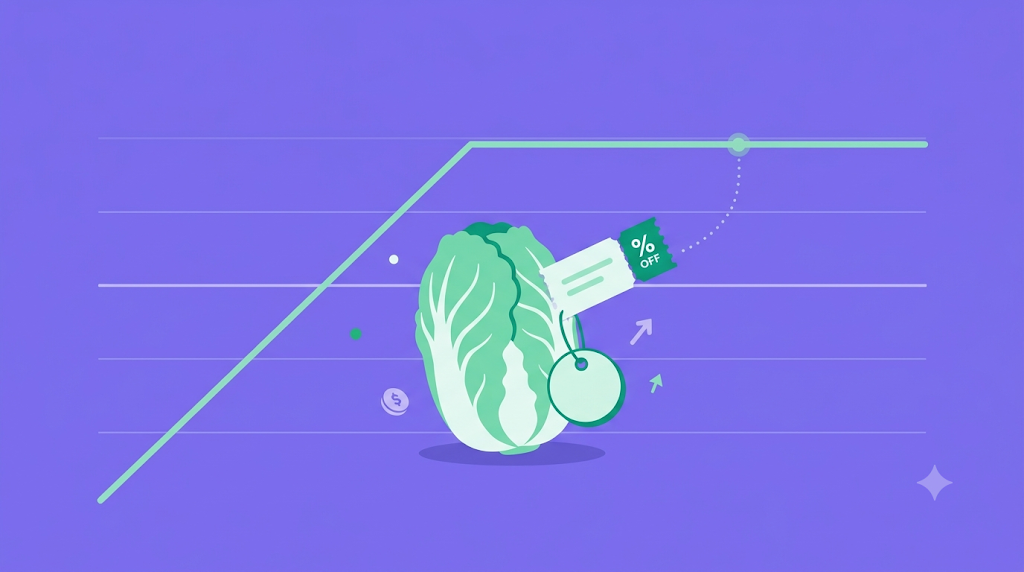
As kimjang season (Korea’s traditional kimchi-making season) approaches, cabbage prices swing widely depending on that year’s weather. Say a single head of cabbage costs 3,000 won right now. Now imagine a vendor selling a coupon that says: “Buy this coupon, and no matter what cabbage costs a month from now, you can still buy it at today’s price of 3,000 won.” The coupon itself costs 300 won. This coupon has exactly the same structure as a call option.
1The Person Who Buys the Coupon The Call Buyer
If a typhoon sends the cabbage price soaring to 6,000 won, the coupon holder still gets to buy at 3,000 won and comes out well ahead. On the other hand, if a bumper harvest drops the price to 2,000 won, the buyer simply lets the coupon go unused and buys at the market price of 2,000 won instead — so the loss is capped at the 300-won coupon price.
2The Person Who Sells the Coupon The Call Seller
The vendor selling the coupon pockets the 300 won upfront. If the cabbage price doesn’t rise — or falls — nobody uses the coupon, and that 300 won stays as pure profit. But if a typhoon sends the price soaring to 6,000 won, the vendor still has to hand over cabbage worth 6,000 won for only 3,000 won, missing out on that entire gain. As we’ll see, the ETF JEPQ actually plays the same role as this vendor.
How Selling Call Options Works in Practice
Now that you understand call options through the cabbage analogy, let’s look at how selling call options actually works in real financial markets. A prime example is JEPQ, a monthly-dividend ETF. JEPQ’s return comes from two combined sources: the value swings of directly holding stocks in the Nasdaq-100 index, and the premium earned by selling call options on that index. That premium is the core source of the monthly dividend payment.
The Outcome Depends on Market Conditions
Another Way to Sell Call Options: The ELN
Selling exchange-listed call options directly isn’t the only way to do this. JEPQ takes a slightly different approach — through a security called an ELN.
Think of It as a Bank’s Written IOU
Normally, the vendor (JEPQ) would need to go out into the market and sell the cabbage coupons itself. Instead, JEPQ hands this job off to a large bank acting as a wholesaler: “Bank, go run the coupon business in the market for me — and hand over whatever you make.” The bank turns this promise into a single piece of paper and gives it to JEPQ, and that piece of paper is the ELN. In other words, an ELN is essentially a written IOU from the bank saying, “I’ll give you the money I made from the coupon business, later.”
Why Bother Using an ELN?
Why go through the trouble of routing this through a bank when you could just sell the options directly? There are three reasons.
1It Simplifies Tax Calculations
Selling options directly splits the premium earned into pieces classified as capital gains or return of capital, which complicates tax calculations. The ELN approach, by contrast, lets the fund pay out the entire premium cleanly as a dividend. In exchange, it gives up the chance to have any of that treated as lower-taxed long-term capital gains.
2It Sells Without Disrupting the Market as Much
A fund selling call options at scale is like a massive vendor managing tens of billions of dollars in assets. If JEPQ dumped that volume of coupons onto the market all at once, the coupon price itself would swing wildly. Banks, on the other hand, handle large-scale trading every day as a matter of course, so they can break the volume up across many days and conditions, reducing the market impact.
3It Spreads Risk Across Multiple Banks
Funds that use ELNs don’t put all their eggs in one bank’s basket. JEPQ follows similar principles to spread out its risk.
A Hidden Risk Worth Knowing
At the end of the day, an ELN is a debt instrument issued by a bank. That fact adds one more layer of risk for investors in ETFs like JEPQ that sell call options through the ELN structure.
Compared With Selling Directly
What We Covered Today
Closing Thoughts
Terms like call option and ELN might feel unfamiliar at first, but the underlying logic is simple. Selling a call option means promising to sell at today’s price regardless of where the price ends up, and collecting payment upfront. An ELN is just a certificate the bank writes up to carry out that promise on your behalf.
Applying this structure to a real example: JEPQ generates steady dividends when the market is flat or rising modestly, but it also has the limitation of not capturing the full upside when the market surges. On top of that, it’s worth remembering that going through an ELN means also taking on the bank’s credit risk.
In the end, selling call options is one answer to the question, “How much upside am I willing to give up in exchange for how much steady cash flow?” — and JEPQ is a prime example of that answer built into a real product.