When you start investing, there are two words you’ll run into right away: stocks and bonds. News headlines often say things like “stocks fell as the U.S. 10-year Treasury yield rose,” yet rarely does anyone stop to clarify what actually separates the two. Let’s build up from these most fundamental concepts in investing, one step at a time.
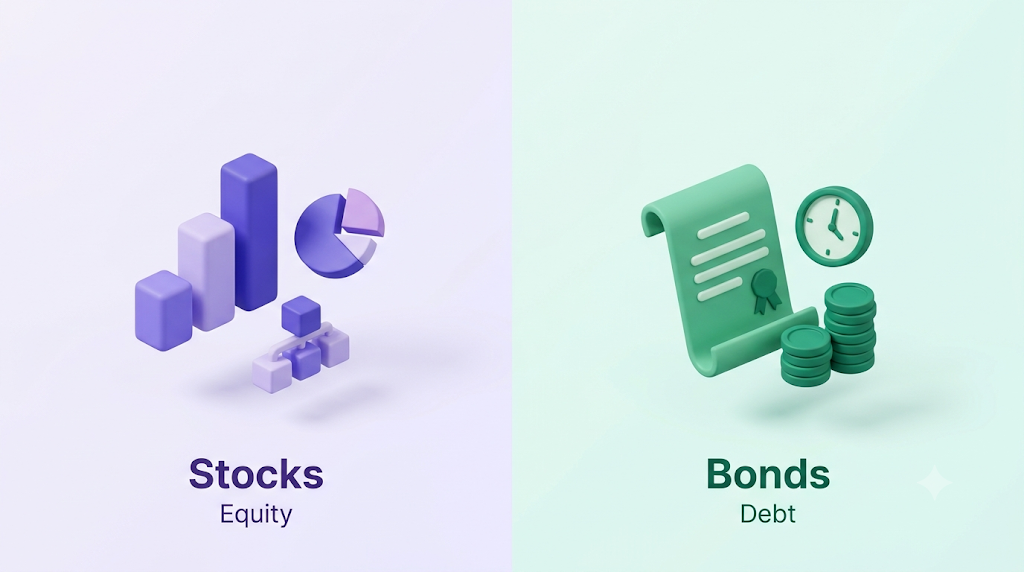
These two concepts might look complicated, but the core idea is simple. The line below is where every other difference starts — nearly everything else follows from it.
Buying a stock
You become a part-owner of that company
You hold a small slice of the company’s ownership.
Buying a bond
You lend money to that company (or country)
You hold a written promise to be repaid interest and principal.
A stock is an ownership stake. A bond is an IOU. Understanding just this difference makes the news a lot easier to follow.
SECTION 02
What Is a Stock
What is a stock
A stock is a certificate representing a small slice of a company’s ownership. If you buy one share of Samsung Electronics, you become one of the company’s part-owners — however small your share.
1What You Get as a Shareholder
Capital gains — As the company grows and its value rises, the stock price rises with it, and you profit from the difference.
Dividends — The company shares a portion of its profits with shareholders. That said, many companies don’t pay dividends at all.
Voting rights — You can vote on major company decisions at the shareholders’ meeting.
2Characteristics of Stocks
If the company does well, there’s no cap on your potential gain — 10x, even 100x is possible. On the flip side, if the company fails, you can lose your entire investment. And unlike bonds, stocks have no maturity date, so you keep holding them until you decide to sell.
SECTION 03
What Is a Bond
What is a bond
A bond is essentially a written promise: “I lent you money, and you’ll pay me a set amount of interest by certain dates and repay the principal by a certain date.”
1Three Things Fixed When You Buy a Bond
Term
Meaning
Face value
The principal you’ll get back at maturity
Coupon rate
The interest rate you’ll receive periodically
Maturity
The date you get your principal back
2Characteristics of Bonds
As long as the issuer doesn’t default, you receive the fixed interest and principal you were promised. No matter how well the company does, the amount you receive doesn’t grow. Conversely, even if the company’s performance suffers, you still get the promised interest as long as it doesn’t fail outright. And unlike stocks, bonds have a maturity date.
SECTION 04
Who Gets Paid First If a Company Fails
This is where the risk difference between stocks and bonds shows most clearly. When a company goes bankrupt, its remaining assets are divided up in a fixed order.
1st · Secured creditors
↓
2nd · Unsecured creditors (corporate bondholders)
↓
3rd · Preferred shareholders
↓
4th · Common shareholders (last in line)
In other words, creditors must be paid in full first, and shareholders only get whatever is left over. In practice, there’s usually nothing left, which is why stocks often become worthless in a bankruptcy.
Bonds are relatively safe but come with a capped return. Stocks are riskier but have no cap on potential return.
Advertisement
SECTION 05
Types of Bonds — Based on Who’s Borrowing
1Classification by Issuer
Type
Issuer
Characteristics
Government bonds
National government
Considered the safest option; repaid as long as the country doesn’t collapse
Municipal bonds
Local government
Slightly riskier than government bonds, with slightly higher yields
Special bonds
Public corporations, etc.
Widely seen as effectively backed by the government
Corporate bonds
Private companies
Risk and yield vary widely based on the company’s creditworthiness
The core principle
The higher the risk, the higher the interest rate. A company with lower creditworthiness has to promise a higher interest rate to borrow money. Conversely, bonds seen as safe, like U.S. Treasuries, attract buyers even at low interest rates.
2Credit Ratings
Corporate bonds are rated by credit rating agencies. Ratings run from AAA down through AA, A, and BBB; BBB and above is called investment grade, while anything below that is speculative grade, more commonly known as high yield. True to their name, high-yield bonds pay higher interest, but they also carry a correspondingly higher risk of default.
SECTION 06
What Are 10-Year and 30-Year Bonds — Maturity and Duration
The “10-year” in the frequently mentioned “U.S. 10-year Treasury” simply means a bond with 10 years left until maturity.
Short-term bonds
Usually mature in 1-3 years or less
Medium-term bonds
3-10 years
Long-term bonds
10 years or more (20-year, 30-year, etc.)
1Why a Longer Maturity Means More Risk
The longer the maturity, the less predictable what might happen in between. Interest rates could rise, or inflation could spike. That’s why, generally speaking, longer maturities come with higher interest rates — it’s the price you’re paid for locking up your money for longer.
What is duration
Duration measures how sensitive a bond’s price is to changes in interest rates. The longer a bond’s maturity, the more its price swings when rates move. If market rates rise by 1%, a short-term bond’s price falls only slightly, while a 30-year long-term bond’s price falls much more sharply.
This is exactly why people find themselves asking, “Long-term bonds are supposed to be safe — so why am I losing this much money?”
SECTION 07
Why Do Bond Prices and Interest Rates Move in Opposite Directions
This is the part beginners find most confusing. An example makes it simple.
You buy a bond paying 3% annual interest for 1,000,000 won
↓
Market rates rise → new bonds now pay 5% annual interest
↓
No one wants to pay 1,000,000 won for your 3% bond anymore
↓
To sell your bond, you have to lower its price
When market interest rates rise, existing bond prices fall. When rates fall, existing bond prices rise.
📌 Go deeper — Curious why interest rates rise and fall in the first place, and who decides them? ‘Understanding Interest Rates and Bonds’ walks through the policy rate, Treasury yields, and the yield curve.
Advertisement
SECTION 08
Why the U.S. 10-Year Treasury Yield Matters
The U.S. 10-year Treasury yield serves as a benchmark for asset prices worldwide. There’s a reason it shows up in the news so often.
The U.S. 10-year yield is essentially “the return you get for locking your money into the safest possible asset for 10 years.”
When it rises, taking on risk by investing in stocks becomes relatively less attractive, because the interest you can earn safely has gone up.
That’s why the stock market often gets rattled when the 10-year yield spikes.
Why are tech stocks more sensitive to interest rates?
Interest rates also affect the discount rate used to convert a company’s future earnings into present value. That’s why growth stocks (like tech companies), which are valued based on profits expected far in the future, react more sharply to rising rates.
📌 Go deeper — The gap between the 10-year and 2-year yields — the yield curve and what an inversion signals — is covered in ‘Understanding Interest Rates and Bonds’.
SECTION 09
The Basics of Asset Allocation — Why Hold Both Together
Stocks and bonds tend to behave differently under different conditions, which is why investors typically hold both.
When the economy is strong
Stocks tend to perform well.
During a downturn or uncertainty
Money tends to flow into bonds as a safe haven.
A “60% stocks, 40% bonds” split is often cited as the classic example of asset allocation. That said, it’s not a fixed answer — just a starting point. The right ratio should vary based on your age, investment horizon, and how much loss you can tolerate.
Stocks and bonds don’t always move in opposite directions. During periods of sharply rising interest rates, both can fall at the same time.
SUMMARY
Comparison at a Glance
Category
Stocks
Bonds
Your position
Part-owner (equity holder)
Creditor (lender)
How you earn
Capital gains + dividends
Interest + principal (at maturity)
Return cap
None
Fixed
Maturity
None
Yes
Priority in bankruptcy
Last
Ahead of shareholders
Voting rights
Yes
No
Risk level
Relatively higher
Relatively lower
Minimum Checklist
Do you understand that a stock is an ownership stake while a bond is an IOU?
Do you know that creditors get paid before shareholders if a company fails?
Do you know how government, municipal, special, and corporate bonds differ?
Do you understand the principle that higher risk means higher interest rates?
Can you explain why existing bond prices fall when interest rates rise?
Do you know why the U.S. 10-year Treasury yield affects the stock market?
The foundation of investing ultimately starts with knowing exactly what you’re buying.
Advertisement
CONCLUSION
Closing Thoughts
Buying a stock makes you a part-owner of a company. Buying a bond makes you a lender. Once you clearly understand this one simple distinction, everything else connects naturally — who gets paid first in a bankruptcy, why bond prices fall when rates rise, and why the U.S. 10-year yield can rattle the stock market.
The moment the news starts making sense is exactly where your investing education begins.
This document was written for general investment education purposes and does not recommend buying or selling any specific security or product. Last updated: July 2026