LNG Industry Structure: Alaska LNG and Asia’s Buyers

Alaska LNG is a massive U.S. energy project that has been discussed for decades. In 2016, major energy companies such as ExxonMobil, BP, and ConocoPhillips chose not to advance it, citing poor economics. Since 2025, however, a new developer has taken the lead and buyers across Asia, from Japan and Korea to Taiwan and Thailand, have started signing on, giving the project fresh momentum.
Why is a project that U.S. majors once walked away from back on track? Who will buy this LNG, who will pay to build it, and will it actually make money? In this article, we look past the political announcements and focus on the project’s structure and the numbers.
What Is Alaska LNG?
1Project Structure
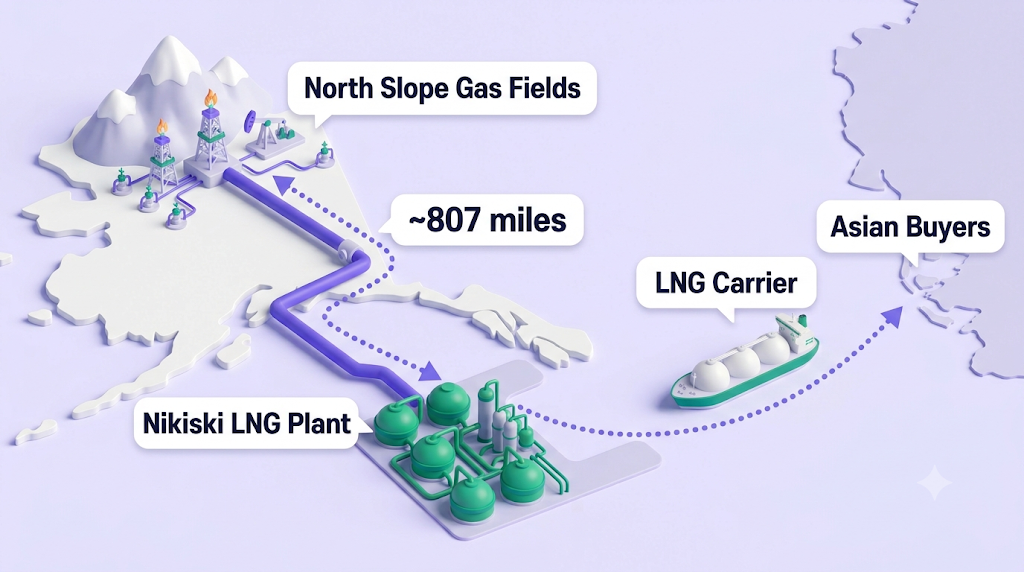
Put simply, Alaska LNG is a project to liquefy natural gas produced in Alaska and export it to Asia.
Alaska’s North Slope holds substantial natural gas reserves. The problem is that the gas sits far from any export port. So the plan is to build a long-distance pipeline of about 807 miles (1,300 km) to carry the gas south, liquefy it in Nikiski in southern Alaska, and ship it on LNG carriers to Japan, Korea, Taiwan, Thailand, and other Asian markets.
2Project Scale
The current plan calls for exports of about 20 million metric tons per year, and the money required is just as enormous.
Why It Stalled Before, and Why It’s Moving Now
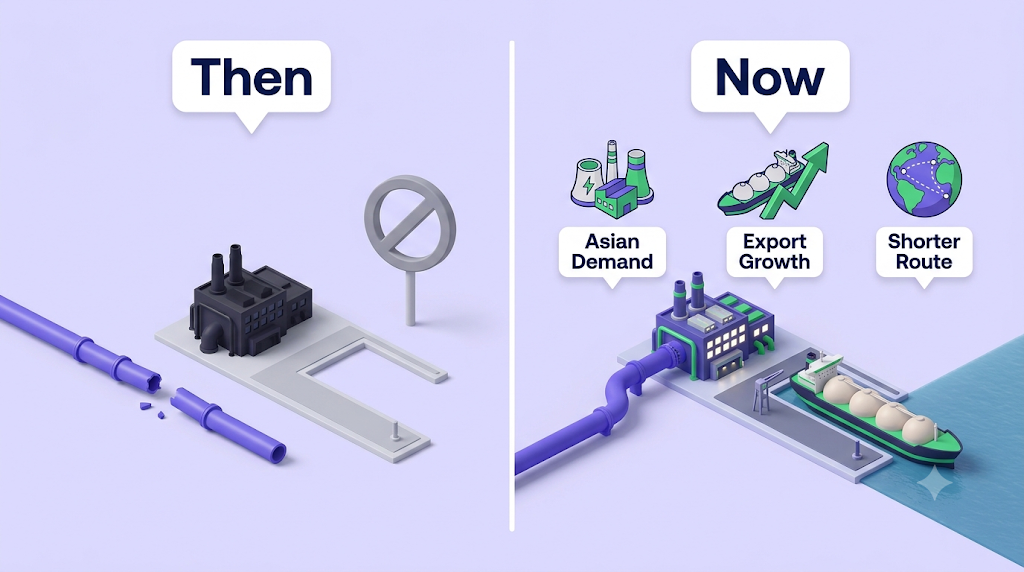
1The Economics Didn’t Work
Alaska LNG was never a project nobody cared about. It has been pursued in one form or another for decades. But the costs were daunting, and the U.S. energy market was shifting underneath it.
In the end, the majors concluded that the economics didn’t work and declined to move on to the next stage of investment.

2What Changed: The Developer
One of the biggest changes is who is leading the project. In 2025, U.S. energy developer Glenfarne took over as lead developer, and work began moving forward in earnest again.
But the cost is still enormous. For the project to succeed, having plenty of gas isn’t enough — it has to sell LNG at a price that covers the high construction costs and still turns a solid profit.
3Why Revive It Now?
Several conditions are different today. LNG demand in Asia — including Japan, Korea, Taiwan, and Thailand — remains strong, and the U.S. is pushing to expand LNG exports. Alaska also offers a far shorter shipping route to Asia than the U.S. Gulf Coast does.
Who’s Buying, Who’s Investing?
1Buying LNG vs. Investing in the Project
When following Alaska LNG news, it helps to separate “who is buying the LNG” from “who is putting money into the project.” When companies in Japan, Taiwan, Thailand, France, and Korea sign long-term contracts to buy LNG, that’s very different from a country or company investing in the project itself.
2Why Long-Term Purchase Contracts Matter
Glenfarne is currently lining up long-term LNG purchase agreements with buyers overseas. Preliminary long-term agreements now cover about 13 million metric tons per year, and the goal is to lock in about 80% of total capacity under long-term contracts.
A large LNG project requires tens of billions of dollars up front. If it’s unclear who will buy the LNG once the plant is finished, lenders will be reluctant to finance it. On the other hand, if long-term purchase contracts are in place, future cash flows become reasonably predictable. That’s why securing long-term purchase contracts is a key condition for financing large energy projects.
3Why Asian Partners Matter
Asia is Alaska LNG’s main market. Japan and Korea are among the world’s largest LNG importers, and most of the companies that have signed preliminary purchase agreements are Asian.
Asian partners do more than just buy LNG. Korea is a global leader in building LNG carriers and has strong steel and plant-equipment industries, and POSCO International has committed not only to buying LNG but also to supplying steel for the pipeline and taking an equity stake.
4Asia’s Shifting LNG Supply
Asian buyers are already diversifying their LNG supply. Korea is a clear example. In 2024, Korea’s top LNG suppliers were Australia, Qatar, Malaysia, the U.S., and Oman, in that order. When long-term contracts with Oman and Qatar expired at the end of that year, Korea Gas Corporation (KOGAS) selected several U.S. companies to supply replacement volumes.
In March 2026, Iranian missile strikes damaged part of Qatar’s Ras Laffan LNG facilities, knocking out about 17% of Qatar’s LNG export capacity. QatarEnergy said repairs would take three to five years and declared force majeure (a measure that excuses a supplier from its contractual delivery obligations) on long-term contracts with some buyers in Korea, China, Italy, and Belgium.
Why Is the U.S. Pushing Alaska LNG?
1What the U.S. Government Says It Means
Washington links Alaska LNG to several policy goals. If the project goes ahead, it will require large-scale infrastructure investment not only in the gas fields but also in pipelines, LNG plants, and ports, so for the U.S., it’s about more than just LNG.
2Alaska LNG in Trade Talks
Alaska LNG has also come up in trade and investment negotiations between the U.S. and its Asian allies. Korea is a prime example. On September 30, 2026, the U.S. government said Korea would invest more than $50 billion in Alaska LNG, but the joint fact sheet released by the Korean government says only that Korea will begin reviewing the project, provided it is commercially reasonable. The amounts cited by Washington have also varied over time.
Japan’s situation is similar. When the U.S.–Japan trade deal was struck in July 2025, President Trump talked up a joint venture with Japan on Alaska LNG, but the agreement itself said only that the two sides were exploring a new offtake agreement. Japan pledged a $550 billion U.S. investment package, and Alaska LNG has been floated as a candidate for that money, but no specific amount has been set aside for Alaska.
The most accurate way to see it: the U.S. has asked its partners to invest, and that is where things stand. Rather than treating any figure as a confirmed investment, it’s important to recognize that whether and when the money will actually flow has not yet been decided.
Will It Actually Make Money?
1The Profit Structure of an LNG Project
Now for the most important question: if you put money into this project, will it pay off? Here we need to set politics aside for a moment and look at the business itself. Costs arise at every stage of an LNG project, and in the end the project only works if the LNG sales price is comfortably higher than all of those costs.
2A Simple Calculation
The calculation below is not an actual estimate of Alaska LNG’s profitability. It is a hypothetical example to help explain the project’s structure.
If LNG sells for $10 and total costs are $8, $2 is left over. But if the sales price falls, or construction and operating costs come in higher than expected, that margin can shrink quickly. Conversely, if LNG prices stay high enough and long-term contracts are firmly secured, the project’s profitability can improve.
3Where Does the Money Flow?
If Alaska LNG goes ahead, the money won’t flow to just one place. It will spread across multiple industries along each stage of the process.
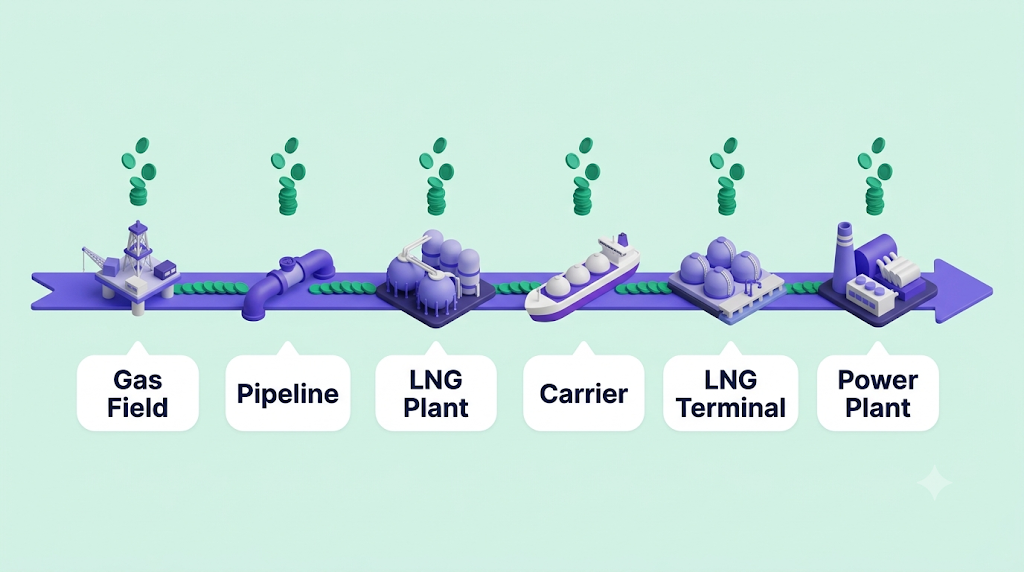
Gas production Upstream
Infrastructure Midstream
Transport & storage Logistics
Consumption Downstream
4Five Things to Watch
When following Alaska LNG, look past the headlines to the numbers that show how far the project has actually come.
1Total project cost
Watch whether the currently cited range of about $44.5–54.5 billion holds. If costs keep rising, that weighs on profitability.
2Long-term LNG contract volume
The key is whether the current ~13 million metric tons per year actually reaches the 16 million metric tons per year financing target.
3LNG sales price
The price at which LNG can be sold ultimately determines the project’s profitability.
4Partner investment terms
What matters is how much Asian partners such as Korea actually invest, and on what terms. Whether announced amounts turn into real contracts is a key variable for financing the project.
5Tax and legal support
Another key variable is how the State of Alaska and its legislature settle the tax and legal framework to support financing. In July 2026, after a veto threat from the governor, the Alaska House voted down a tax break for the gas pipeline. This is worth continuing to watch when judging whether the project can actually move into the financing stage.
Which Companies Are Involved?
As the project moves forward, money will flow across multiple stages: gas production, pipeline construction, liquefaction equipment, and LNG purchasing. Based on contracts and announcements made public so far, here is a stage-by-stage look at the companies involved, from U.S.-listed firms to Asian partners.
1Equipment & Technology — Baker Hughes (NASDAQ: BKR)
U.S. energy technology company Baker Hughes signed a firm contract with Glenfarne in November 2025. It will supply the main refrigerant compressors — core equipment for the LNG terminal — and power generation equipment for the North Slope gas treatment plant, and it has also committed to a strategic investment in the project.
2Pipeline Engineering & Construction — MasTec, Quanta Services, Worley
On the pipeline side, the companies handling everything from design to construction have already been lined up.
3Gas Supply — ConocoPhillips, ExxonMobil
ConocoPhillips (NYSE: COP), ExxonMobil (NYSE: XOM), and UK-listed Pantheon Resources (AIM: PANR) have signed preliminary gas sales agreements. In other words, ConocoPhillips and ExxonMobil, two of the majors that walked away in 2016, are now back in the picture as gas suppliers.
4Asian Partners — POSCO International and LNG Buyers
Korea’s POSCO International (KRX: 047050) signed the project’s first heads of agreement (HOA) with Glenfarne in December 2025. It agreed to buy 1 million metric tons of LNG per year for 20 years and to supply steel for the pipeline, and it is reported to hold a stake of about 3.5%. The company has described this as a minority stake aimed at securing steel supply rights and priority access to LNG.
In addition, JERA and Tokyo Gas (Japan), CPC (Taiwan), PTT (Thailand), and TotalEnergies (France, NYSE: TTE) have signed preliminary purchase agreements. These companies are locking in future supply rather than benefiting from construction.
Alaska LNG by the Numbers
Final Thoughts
Alaska LNG isn’t just a story about “the U.S. exporting more LNG.” It is a massive infrastructure project costing tens of billions of dollars, and one that struggled to move forward in the past because of its economics.
The reasons it is being revived now aren’t simple either. Asian LNG demand and shifting supply, the U.S. push to expand LNG exports, Alaska’s geographic position, and trade and investment negotiations between the U.S. and its Asian allies are all intertwined.
Alaska LNG’s real value won’t be settled by political announcements. It will become clear once the numbers — project cost, contract volumes, sales price, and partner investment terms — are actually filled in.