The 5 Layers of the AI Industry
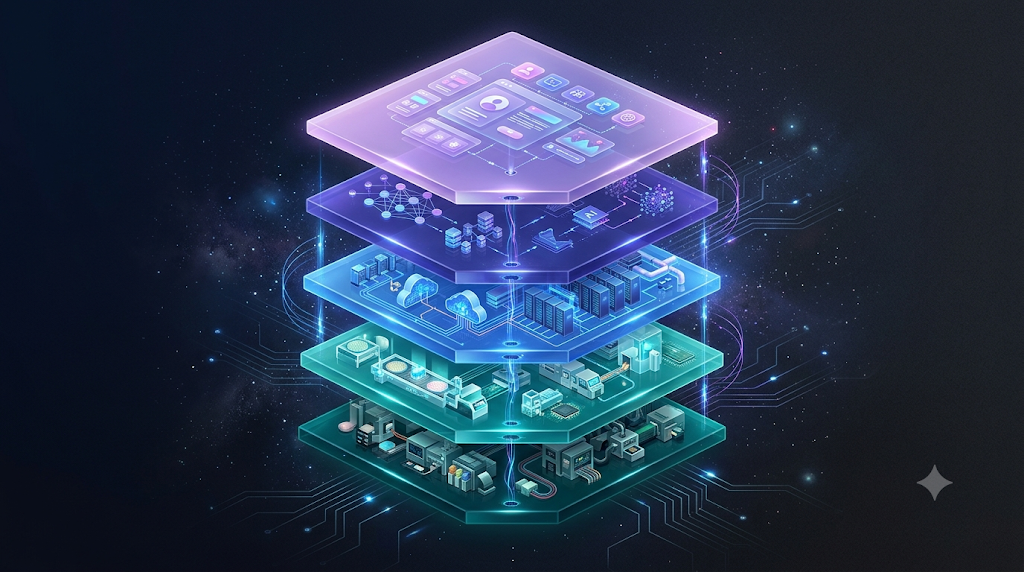
The AI industry structure is something anyone investing in AI stocks these days has probably wondered about at some point. But if someone actually asks you, “So what exactly do these companies give each other?” — it’s often surprisingly hard to answer. NVIDIA, TSMC, SK Hynix, cloud companies, AI model companies — the names are all familiar, but exactly how they connect to one another tends to stay fuzzy. So in this article, we’ll walk through how the AI industry actually flows together, from AI chips all the way to the cloud and software, as simply as possible, one layer at a time.
The 5 Layers That Make Up the AI Industry
That brief moment when we ask AI, “Explain this to me,” and get an answer back. Behind that single reply, five industry layers are actually interlocking like links in a chain.
The AI industry is made up of five layers stacked from the bottom up. The layer below is the “material” for the layer above, and the layer above is the “customer” of the layer below. The lower layers form the manufacturing supply chain that makes AI chips, while the upper layers are the services and software that run on top of them. We’ll first take a quick look at the full picture, then start from the top “apps” layer and work our way down to “materials and equipment” at the very bottom — that is, from Layer 5 down to Layer 1 — one layer at a time.
Layer 5 — Applications
You type a question into the chat box and get an answer back. But here’s the important thing: the app itself is actually pretty close to a “shell.” It’s really just a pretty chat window, a login button, and a screen that shows your conversation history — the “brain” that actually answers your question isn’t inside the app at all.
What the App Actually Does
The app just sends your question somewhere else and neatly displays whatever answer comes back. Think of it as the “counter” going back and forth between the customer and the kitchen. So where’s the “brain” that’s actually doing the cooking?
We cover how ChatGPT, Claude, and Gemini differ, and why this layer gets called a “shell.”
Layer 4 — AI Models
Why “Training” Is the Key
AI isn’t a search engine that fetches a pre-set answer. It has to have already read internet-scale volumes of text and absorbed the patterns of language and knowledge wholesale, so that it can construct sentences and answer even questions it’s never seen before. This “reading and absorbing” process is what’s called training, and the end result is one enormous model.
In other words, here’s how the app from the previous section relates to this model: the app hands the question off to the brain (the model), then takes the brain’s answer and shows it to you. An app without a brain is nothing more than an empty chat window.
We cover how models get trained, why it’s so expensive, and how it differs from open source.
Layer 3 — Infrastructure & Cloud
1Cloud
It comes down to scale. Training a model takes months of staggering amounts of computation, and once training is done, answering questions in real time from hundreds of millions of people worldwide requires a massive computer running non-stop. Forget a laptop — you need a data center just to keep up. So instead of building all their own data centers, model companies (OpenAI, Anthropic, etc.) rent this cloud capacity to run their brains. Within the AI industry structure, cloud essentially acts as “the wholesale distribution network for computing power.”
We cover how AWS, Azure, and Google Cloud differ, and why they’re even building their own AI chips.
2Cooling
When tens of thousands of GPUs run non-stop, they generate a tremendous amount of heat. If that heat isn’t dissipated in time, servers throttle themselves or shut down. That’s why cooling equipment matters just as much as servers and power inside a data center. Air cooling alone has recently become insufficient, so liquid cooling, which dissipates heat directly with liquid, is rapidly gaining ground. For cloud companies, cooling is a cost nearly as large as buying GPUs — and it’s also what determines how densely they can build out a data center.
We cover why GPU heat suddenly became a problem, and what liquid cooling actually is.
3Power
Running tens of thousands of GPUs non-stop takes about as much power as a decent-sized city. Securing that power has recently become the very bottleneck that determines how fast data centers can be built. That’s why big tech companies like Microsoft, Amazon, and Google are signing direct, long-term power supply deals with nuclear plant operators. Companies like Constellation Energy, the largest nuclear operator in the U.S., and GE Vernova, which supplies gas turbines and grid equipment, are key players in this power supply chain.
We cover why big tech is signing direct deals with nuclear operators.
4Networking & Optics
What this layer does is simple. No matter how good a single server is, it can’t train a large AI model on its own. So tens of thousands of servers get wired together with dense fiber-optic cables to behave like one giant supercomputer. If this connection is too slow, even a huge pile of great GPUs ends up performing at only half capacity.
We cover how it differs from HBM, and what CPO technology is.
Layer 2 — Chip Manufacturing
1Memory, CPUs & Storage
1Memory (DRAM/HBM)
Like the RAM in your PC, this is an ultra-fast warehouse that stages data right next to the chip for calculation. No matter how fast a compute chip is, it sits idle if data can’t be fed to it fast enough — and since AI deals with such massive amounts of data, this feed speed directly determines AI performance. That’s what led to HBM (High Bandwidth Memory): a component that stacks multiple memory chips vertically, letting it exchange data far faster than ordinary DRAM.
South Korea’s SK Hynix leads in HBM, with Samsung and Micron close behind. This is one of the big reasons Korea keeps coming up in conversations about the AI boom.
2CPU
The GPU (covered next, in chip design) has an overwhelming edge for AI computation itself, but that doesn’t mean CPUs go unused. GPUs handle almost all of the actual model-training process, but the steps before and after “inference” — receiving a user’s question, processing it, and returning the results as a sentence — plus coordinating the server as a whole, are still handled by the CPU.
This market has traditionally been split between Intel and AMD. That said, this layer has also drawn relatively less attention than GPU makers in the recent AI boom.
3Storage (SSD/HDD)
Easy to confuse with memory, but the role is different. If memory is a “workbench” that temporarily holds data needed for calculation right now, storage is the warehouse that keeps large volumes of data long-term, like training data or finished model files. The biggest difference from memory is that data stays put even when the power’s off.
This market is split between Samsung and SK Hynix (NAND flash) and SanDisk, Seagate, and Western Digital. As AI data centers grow, demand for this kind of large-scale storage grows right along with them.
We cover the whole memory hierarchy from registers to storage, and why HBM is such a hot topic.
2GPU & Chip Design (Fabless)
The most expensive and important component within this chip-manufacturing layer is the AI compute chip — the GPU. AI computation requires performing the same type of calculation an enormous number of times simultaneously, and the GPU is what’s specialized for exactly that. NVIDIA is the leading company designing these AI GPUs.
Design and Production Are Completely Separate
Chips don’t just fall from the sky. Deciding how to lay out tens of billions of microscopic circuits onto a chip the size of a fingernail is an extraordinarily precise design job that has to happen first. But NVIDIA doesn’t actually own a factory that stamps out chips — it only designs them and hands production off to someone else. This is widely considered the layer with the highest added value in the entire AI industry structure.
We cover why GPUs are so well-suited to AI computation, and what NVIDIA’s real moat actually is.
3Foundries
The fact that design (Layer 3 above) and production (this Layer 2) are split apart reveals something important about this industry: design and manufacturing are run as two completely separate businesses. There’s a company that’s great at design (NVIDIA) and a separate one that’s great at production (TSMC), and each is only half the story without the other.
We cover why TSMC alone effectively holds a monopoly on leading-edge chip production, including the geopolitics of it.
Layer 1 — Materials & Equipment
Only one company in the world — the Netherlands’ ASML — makes the EUV (extreme ultraviolet) photolithography machines needed for the most advanced chips. Without this equipment, neither TSMC nor Samsung can make cutting-edge chips. That’s why this layer is called the industry’s “chokepoint.”
On top of that, the factory can’t run without a supply of materials like the wafer (the silicon disc the chip is built on), the photoresist (the light-sensitive material used to draw circuits), and various specialty gases.
We cover why ASML’s EUV photolithography machines are called the industry’s “Achilles’ heel.”
The 5 Layers of the AI Industry, Summed Up
As we’ve seen working our way down from Layer 5 to Layer 1, the AI industry structure is a system where a single question you ask has to pass through all five layers before an answer comes back to you.
Closing Thoughts
That was the big-picture map of the AI industry structure. The key takeaway is that no layer exists on its own. An app is an empty shell without a model, a model can’t run without the cloud, the cloud can’t function without chips, chips can’t be made without factories, and factories can’t build anything without equipment.
Now that you have this map in hand, you’re ready to dig deeper into each layer, one at a time. Starting with the next article, we’ll work through these five layers in detail, from Layer 5 (Applications) all the way down to Layer 1 (Materials & Equipment).